
TaRL Evidence
Numerous rigorous studies provide consistent evidence of the positive impact of the TaRL approach on foundational literacy and numeracy outcomes.

Journey of TaRL Evaluations
Since 2001, Pratham and J-PAL-affiliated researchers have worked together to evaluate the TaRL approach and various implementation models in India.
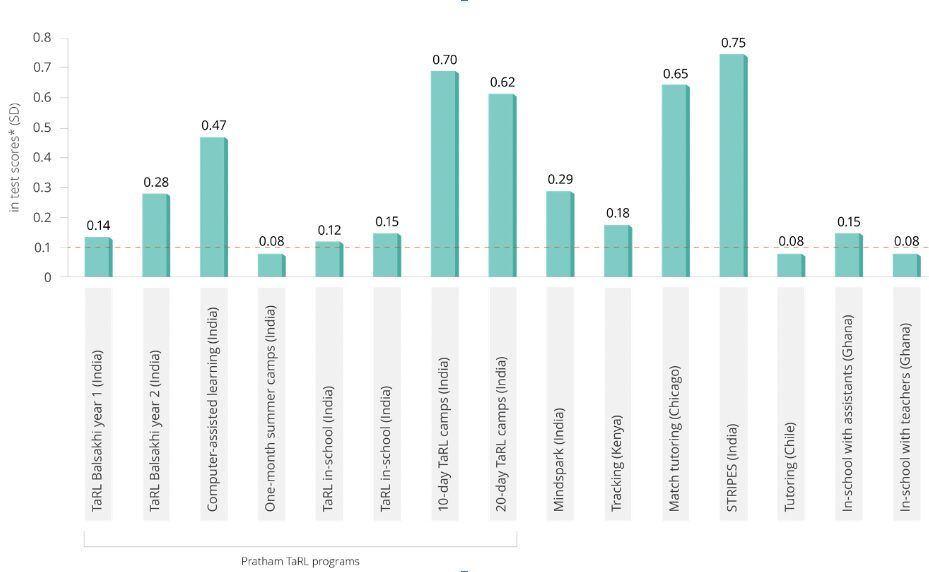
Through six randomised evaluations across seven states in India, they found that when TaRL is successfully implemented, learning outcomes improve – leading to some of the largest learning gains among rigorously evaluated education programs.
Learn more about the history of TaRL’s evidence in India here.
Impact of diverse TaRL or TaRL-inspired interventions
The impact of TaRL is similarly strong in Africa. A recent impact evaluation of TaRL in Madagascar found that for students in grade three, mathematics learning improved by 0.56 standard deviations of test scores. The outcomes from TaRL programmes across countries also show that the approach helps girls and boys equally. A more detailed overview of the history of TaRL’s evidence-to-policy journey over time is available in this J-PAL policy case study here.
Learn more about TaRL’s evidence in Sub-Saharan Africa here.
Note:
*An increase of 0.1 standard deviations is typically considered a small effect
**Tests include a mixture of maths and language assessments
Evidence on Cost-Effectiveness
Considered highly cost-effective at scale and supported by a strong body of evidence, the Global Education Evidence Advisory Panel identified targeted instruction programming such as TaRL as a ‘Great Buy’ for policymakers.