
Assessment
Assessment is at the core of the Teaching at the Right Level (TaRL) approach.
By assessing children one-on-one using a contextually-appropriate, quick and easy-to-administer tool, instructors understand the specific learning needs of each child. Assessment data is used at all levels of implementation to identify gaps, set goals, track progress, and prioritise support .
Assessments enable TaRL implementers to:
1. Bring focus to foundational skills
The tool focuses on the basics, signalling to parents, teachers, and the government system the schooling community that foundational skills are lacking and they matter.
2. Connect with children’s individual needs
The oral one-on-one testing technique connects instructors to the individual learning needs of children and motivates them when children improve.
3. Act on data
The assessment tool directly influences action at different levels:
- By instructors to group children according to learning levels and plan instruction in a targeted manner.
- By mentors to prioritise their support
4. Set achievable goals
The simple assessment tool is designed based on achievable but ambitious learning goals set by the implementers. Everyone understands these goals and the testing tool helps track the progress towards this goal.

The TaRL assessment tool
A simple assessment tool to measure children’s foundational reading and maths skills like word reading and number recognition is a critical component of the TaRL methodology.
TaRL assessment tools are designed according to the following principles:
Achievable Learning Goals
TaRL assessments are created with achievable foundational skills in mind. The contents of these assessments should be aligned with the identified learning goals of the intervention i.e. the appropriate grade and skill level the program is based around.
Simplicity
Assessment tools should be easy to use and interpret. This ensures that everyone within the system can identify what children can do and understand how children are progressing. Instructors can easily assess all children and use the results to target teaching to the needs of the child.
Speed
Assessments should be quick to administer, and not have too many levels or items. They should be short but efficient enough for instructors to conduct one-on-one with a child to understand their learning level.
Context
Assessments should be tailored to each individual context and language. Concepts, themes, words and settings in reading assessments should be contextually appropriate and familiar to children.
How are children assessed
TaRL instructors assess each child using an oral, one-on-one assessment. The interaction between instructor and child is important for building trusting relationships. Before beginning the assessment, instructors try to make the child feel at ease.
Reading Assessment
The reading assessment involves asking a child to read aloud and identifying his/her highest reading level. The tasks typically included in the tool are as follows:
- Recognize letters/ symbols
- Read common everyday words
- Read a simple paragraph (comparable to Grade 1 level)
- Read a short text/ story (comparable to Grade 2 level)
- Comprehension questions based on the story (direct/ indirect fact retrieval)
The tasks are progressive in nature and thus the administration of the tool involves starting at a level and moving up or down depending on the child’s performance. This enables the instructors to complete an assessment quickly.
TaRL Reading Assessment Tool
TaRL reading assessments are adapted to the local language of the area of intervention.

Reading assessment tool in Cinyanja, which is used in Zambia.
Mathematics Assessment
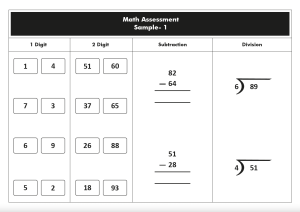
As with the reading assessment, TaRL implementers are encouraged to adapt the process for their own contexts. Typically, the mathematics tasks included in the tool are as follows:
- Number recognition: 1 digit numbers, two digit numbers, or more)
- Basic operations: Addition, Subtraction, Multiplication and Division
All or a subset of the above tasks can be included in the tool. To make the tool progressive, one and two digits recognition tasks, subtraction and division are included. Read more here.
TaRL maths assessments are adapted to suit the local realities of the area of intervention.
FREQUENTLY ASKED QUESTIONS
Have questions about the TaRL approach?
Topics and components of the TaRL approach:

Assessment

TaRL Classroom Methodology

Measurement, Monitoring & Review
