
A decade ago, Zambia took its first bold step toward transforming foundational learning. What began as a small pilot, just 80 schools in 2016, has now grown into Catch Up, a national remedial education programme reaching over 6,000 schools and aiming for full national scale.
The initiative emerged from a simple fact: far too many learners were struggling in national exams and assessments. With support from UNICEF and technical assistance from J‑PAL and Pratham, a team which ultimately evolved into TaRL Africa, and implementation support from VVOB the Ministry of Education set out to test whether the Teaching at the Right Level (TaRL) approach could help children build essential literacy and numeracy skills.
Catch Up was born.
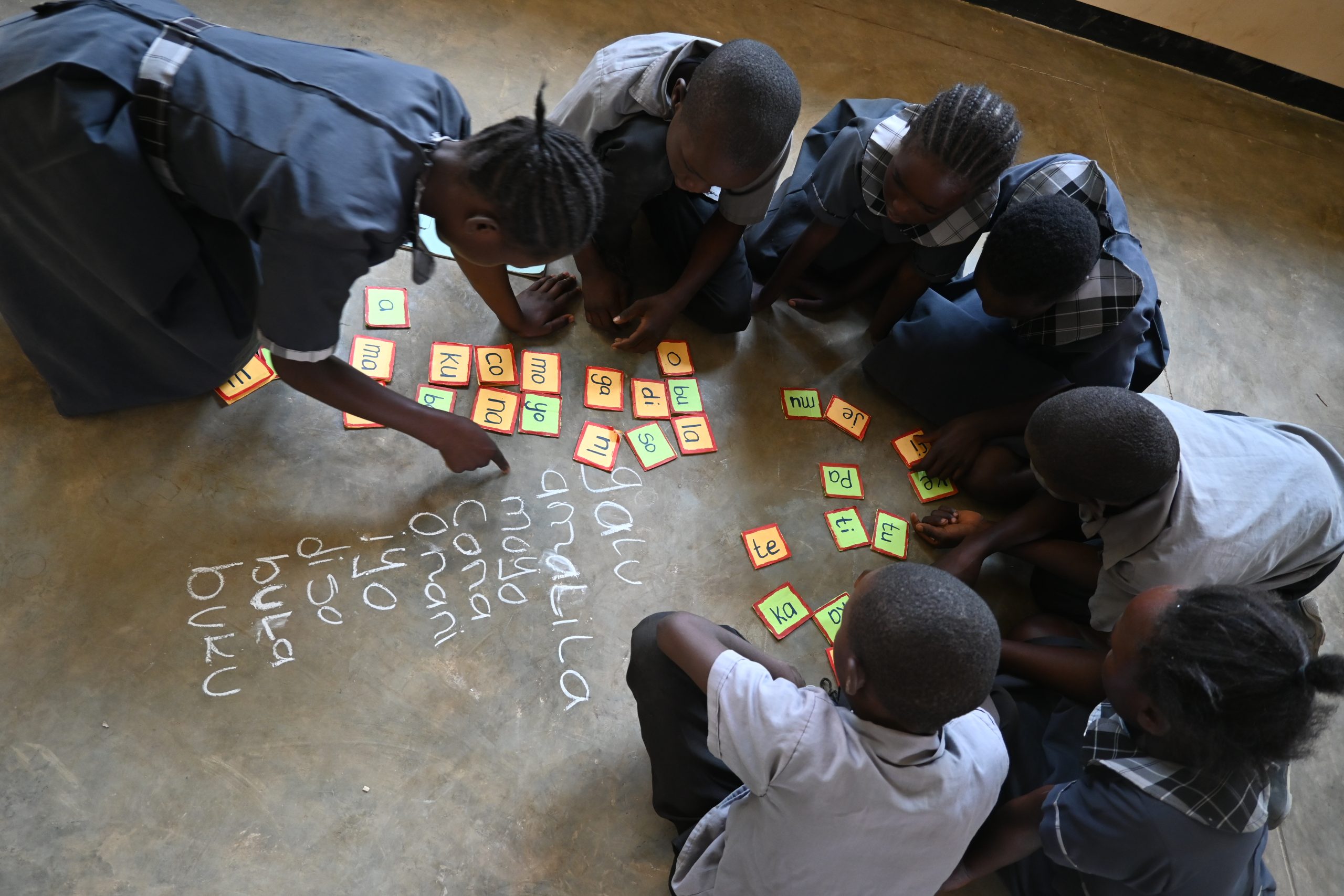
Students participate in literacy activity through Zambia’s program called Catch Up.
The programme targets learners in Grades 3 to 5, offering one hour of structured remedial learning each day. While Zambia continues strengthening the early grades, working toward a future where fewer children require remediation, baseline data show a stark reality: too many children lack the foundational skills needed to access the curriculum. From Catch Up data, only 26% of children can read a basic paragraph when they enter grade 3. Remediation, therefore, is not optional. It is a moral imperative.
Yesterday marked an important milestone. The results of a Randomized Control Trial, to date one of the largest education experiments conducted in Africa, were presented by Principal Investigator Andreas de Barros from the University of California, Irvine. The findings are encouraging: 0.10–0.15 standard deviation gains over two years, equivalent to 2.2–2.8 months of additional learning. These learning gains place the program within the top 20-30 percent of large randomized trials. However, the RCT also highlighted some critical challenges: average daily attendance in school was only 50.4%. This decreased further to 33% during Catch Up time. The study also identifies which skills Catch Up effectively develops and where further refinement is needed.
Ten years on, Catch Up is proving that evidence-based solutions led by the Government can shift learning outcomes at scale, one classroom, one child at a time.
See the full working paper here: https://www.ifo.de/sites/default/files/docbase/docs/cesifo1_wp12542.pdf
And the policy brief here
de Barros, A., & Lubozha, T. (2026). Targeting Foundational Skills at Scale: Skill Specificity and Transfer (Working Paper No. 12542; CESifo Working Paper Series).

