
Author: Titus Syengo “Cholwe”
In the heart of Zambia’s public primary schools, a government-led initiative is quietly transforming learning.
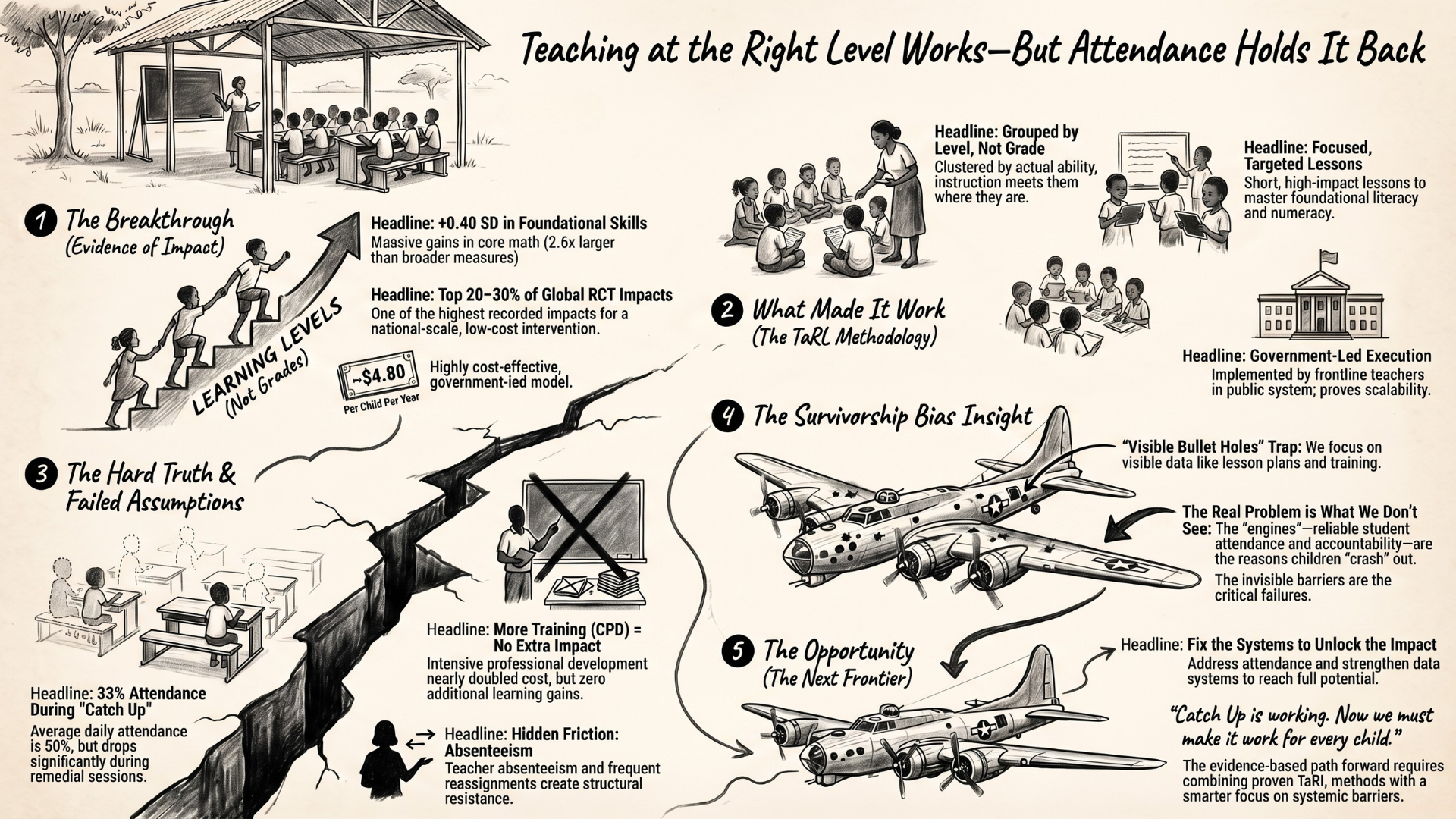
A major randomized controlled trial (RCT) of the national Catch Up program, built on the Teaching at the Right Level (TaRL) approach, has delivered compelling results. After two years, learners showed overall learning gains of 0.10 SD in literacy and 0.15 SD in numeracy. These results place the program in the top 20–30% of impacts from large-scale education RCTs worldwide, a notable achievement for a low-cost intervention at national scale. Even more impressive are the gains on the targeted foundational skills: approximately 0.40 SD in key math competencies (number recognition, addition/subtraction, and multiplication/division), roughly 2.6 times larger than the broader measures. That translates to several extra months of schooling, all at just ~$4.80 per child per year (including technical partner support).
What stands out most is that these gains were delivered by frontline government teachers. They grouped children by actual learning level rather than grade and provided short, focused lessons on exactly what students needed next. This RCT proves that targeted instruction can work effectively at true national scale, even amid the systemic challenges common across Sub-Saharan Africa.
Yet, the study also offers an honest lesson on what doesn’t add extra impact.
Researchers tested adding intensive continuous professional development (CPD) — extra training, mentoring, and communities of practice. The result? No additional learning gains, even though it nearly doubled the program’s cost. This highlights a deeper reality in low-resource education systems: we often invest heavily in visible fixes (curriculum, materials, and training) while overlooking stubborn structural barriers like chronic absenteeism. Evidence-based programs that truly work at national scale, are government-led, and cost only $2–5 per child per year are rare. Most evidence comes from small pilots that are assumed to scale successfully. When one like Zambia’s Catch Up delivers clear results at scale, it’s worth celebrating, even as we honestly acknowledge the remaining gaps. In this RCT, average daily student attendance hovered around 50%, dropping sharply to just 33% during Catch Up remedial sessions. Teacher absenteeism and reassignments added further friction. These are not minor hiccups, but the next strategic frontier which offer strong potential to improve these outcomes.
This brings to mind the classic WWII survivorship bias story. Analysts examined returning bombers full of bullet holes and wanted to reinforce those areas. Statistician Abraham Wald pointed out the flaw: the planes that returned had damage in places they could survive. The real vulnerabilities were the areas with no bullet holes, engines and cockpits, because those planes never made it back. In education reform, we risk the same bias. We focus on the “visible bullet holes” — lesson plans, training, monitoring, and materials — because they generate data. But the critical “engines” that keep children learning are often invisible: reliable attendance, strong data systems, accountability, and removing everyday barriers that keep kids out of school. Zambia’s Catch Up RCT bravely shows both the successes and these overlooked challenges. Targeted instruction can deliver meaningful results even in imperfect conditions. The next frontier is addressing attendance head-on while continuing to refine the program.
At TaRL Africa, we partner with governments to strengthen TaRL implementation and support broader system improvements. This RCT has already opened important conversations with Zambia’s Ministry of Education around attendance, mentoring, data use, accountability, and long-term institutionalization.
The data is clear: Catch Up is working and deserves celebration. Now is the time to build on these successes, tackle the identified gaps, and unlock even greater impact for Zambia’s children. Other African countries can learn from Zambia’s evidence-based, government-owned approach. By combining Teaching at the Right Level with smarter focus on attendance and system enablers, the next chapter can be even brighter. Scaled across nine provinces through sustained government leadership, Catch Up is the continent’s oldest and most extensive TaRL program. Since its inception, Catch Up has been supported by a strong network of partners who provided technical and implementation support as the government implemented it. These include UNICEF, VVOB, TaRL Africa, Pratham, J-PAL, World Vision, and Zambia Open Community Schools.
Learn more: Working Paper | View illustration in full scale: Article Illustration
de Barros, A., & Lubozha, T. (2026). Targeting Foundational Skills at Scale: Skill Specificity and Transfer (Working Paper No. 12542; CESifo Working Paper Series).